

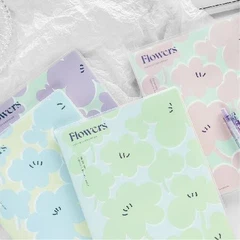
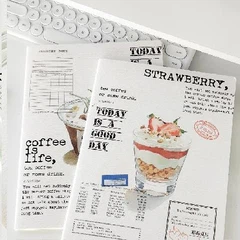
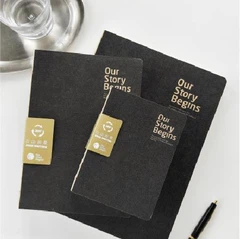
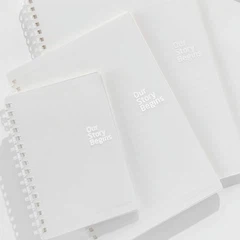


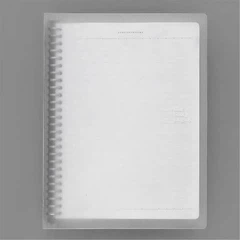
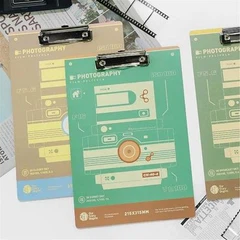
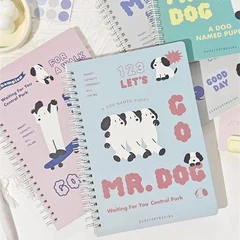
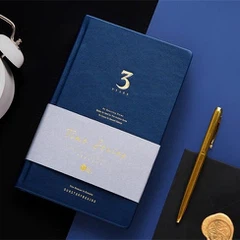
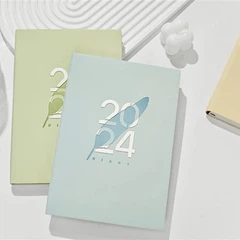
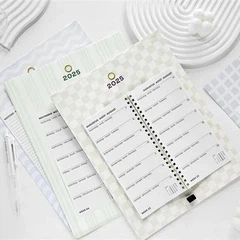
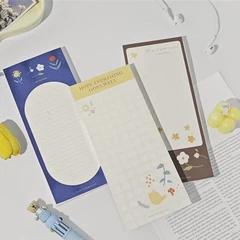
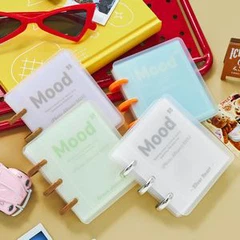
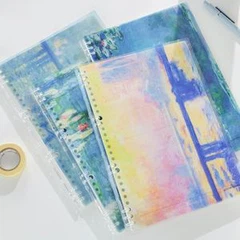

Loose-leaf Notebook
Why Choose Us?
Quality products: We have our own production base, having the ability to produce a full chain assembly line, strictly implementing product standardization, and ensuring product quality.
Competitive advantage: Focuses on the research, development and production of this volume of paper products, has a strong production capacity, and has the research and development capacity of paper printing technology, and independently designs and produces various high-quality stationery Household goods for daily use.
R&D capability: We focus on product innovation, investment in design teams, and talent development, continuously invest in brand communication planning and continuously improve fan stickiness. Make the product a consumer's growth memory and an expressive and communicative carrier.
Professional team: We have a professional design team dedicated to research and innovation, solely for the pursuit of a better writing experience.
What Is a Loose Leaf Notebook
"Loose leaf" describes any kind of paper or book that is available in single sheets, unbound. Its "leaves", or sheets, are "loose" and not bound in notebook or book form. In North America, some textbooks are sold with prepunched holes and perforated pages, so that users can remove the pages and store them in a typical 3-ring binder. This helps in that the user is therefore able to carry only the part of book that is in use with them, without needing to carry the whole book.


Advantages Of Loose Leaf Notebook
Flexibility
The portability and cost-effectiveness of loose-leaf paper are its primary benefits. When using a ring binder, you can take out a sheet of paper that has been punched, utilize it, and then put it back in. Sheets can be rearranged, removed, and refiled in a new binder or discarded as necessary.
Students and others can save time by simply bringing the papers they need for the day and leaving the rest at home, thanks to the flexibility provided by binders' capacity to be easily reorganized and updated.
Ease Of Use
A page from a loose-leaf notebook can be pulled out after it has been recorded without disturbing the other pages. It's not just detachable; it can also be reassembled in different configurations and is simple to fix or alter if necessary. Contents recorded there can be reconstructed if necessary. It's enjoyable and useful in certain contexts, and the former is often the case.
Robust And Trustworthy
The pages of many notebooks are quickly curled and turned up at the corners. Affordable loose-leaf notebooks have made these phenomena obsolete. This notebook style is ideal for people who will be using it regularly for work or school, as it is durable and dependable and can be bound into a more permanent document after use.
Features of Loose Leaf Notebook
These notebooks have various features that make them even more user-friendly and versatile. Depending on which model you choose, your loose leaf notebook might come with the following:
● Pockets for storing loose items
● Special perforated pages that allow you to tear out a page and keep it separately easily
● Reinforced edges that provide extra durability
● Or even a pen loop to hold your writing instrument conveniently
● Some models also offer a variety of colors and designs to suit your style
How to Use a Work Loose Leaf Notebook to Improve Your Productivity
● Use a work loose leaf notebook to focus on work tasks
Simply gather a loose leaf notebook and pen and go to a quiet office, conference room, common area, or outdoor space. Use this distraction-free time to brainstorm, make notes, write down your thoughts, or work on a specific aspect of a project.
● Use a work loose leaf notebook to capture on-the-fly ideas
Writers have used this technique for centuries to capture ideas and inspiration. You don't have to be formal in your note taking; the point is to simply move information from your mind onto physical paper.
You can capture top-of-mind ideas and thoughts, initial plans, and conversation notes. Jot down meeting reflections, figures for upcoming events, project and assignment quotes, and anything else you'd like.
● Use a work loose leaf notebook to track your productivity
Want to keep tabs on how much work you've completed in a single sitting? Productivity tracking is easy with a notebook: No downloads, subscriptions, synching, or maintenance is required.
Simply set up the information you'd like to track. Some ideas include the number of focused work hours, meetings held, or tasks completed. You can also use the loose leaf notebook to track your thoughts, feelings, and energy levels as you begin and end work.
But make sure you have the item by your side so you can use easily locate it and find it and put it into the paces of your work.
● Use a work loose leaf notebook to create a different relationship to your work
It may not seem like it at first, but a work loose leaf notebook gives your thoughts and ideas a tangible form. This is a much different experience than typing or dictating your thoughts into a digital device.
You develop a wholly different physical experience to your work, one that is 100% tactile in nature. You can feel your pen glide across the paper and you can flip through the pages in your hand. You can feel the weight of the loose leaf notebook itself and you can hear the rustle of pages being turned.
The sheer act of writing in a work loose leaf notebook may add a bit of spark to your creativity, help you make previously unseen connections to projects, or allow you to make better decisions based on the information in your hands.

There Are Few Pleasures as Good as a Brand New Loose Leaf Notebook
Binding that allows pages to move 360 degrees is a game-changer for students or professionals who find themselves on the go or needing to effortlessly manage pages.
Not only do you not have to worry about breaking or damaging the binding, you can focus on one single page instead of looking at an entire spread.
Of course, there are lots of other reasons to love a loose leaf notebook, even if you aren't asking hard questions at a press conference. Loose leaf notebooks are great for every profession or student because they come in so many options: Wide-ruled paper, perforated pages, big spirals, small spirals.
There's a loose leaf notebook for everybody.
There's never a wrong time to pick up a new notebook to journal, brainstorm, doodle or inspire better note taking. No matter what your end goal is, it's likely that a loose leaf notebook can get you there.
Try some of these loose leaf notebook suggestions the next time you head to class, a meeting or when you feel the need to doodle, create or write.
Lined Paper: Loose Leaf Notebook
Lined paper, also known as ruled paper, is paper printed with evenly-spaced horizontal lines in order for people to keep their handwriting linear and organized. The lines are usually blue and thin. Lined paper also often comes with two vertical lines on either side of the page, usually pink, to provide margins and tab stops.
Additional vertical lines may be used to create a grid for plotting data, such as graph paper, which is divided into squares by several evenly spaced vertical and horizontal lines.
Before paper was printed like this, the lines had to be drawn by hand. People either ruled their paper with a "hard point" or a "metal point." A "hard point" was a sharp tool that left embossed lines on the paper without any ink or color. A "metal point" was a tool that left colored line marks on the paper, which looked similar to graphite, but other metals were used as well.
This went on for several centuries until 1770, when a man named John Tetlow received a patent for a line-drawing machine, which he called the "Tetlow," named after himself. The British government described the device as a "machine for ruling paper for music and other purposes."
Lined paper has evolved considerably since the 1770s and now comes in a wide variety of forms and types.

Even in the age of digital devices, loose leaf notebook remain popular for several reasons:
Tangibility: There's something satisfying about physically writing down your thoughts and ideas. Writing by hand helps to engage your mind in a different way than typing on a keyboard.
Convenience: Unlike digital devices, loose leaf notebook don't require batteries or an internet connection. You can use them anytime and anywhere, without worrying about a low battery or connectivity issues.
Creative outlet
Many people find that writing by hand is a creative outlet that helps them to generate ideas and express themselves in ways that are different from typing on a computer or phone.
Memory retention
Studies have shown that taking notes by hand can help with memory retention. Writing by hand helps to engage your brain in a way that typing doesn't, making it easier to remember what you wrote.
Personalization
With personalised notebooks, you can customize your experience to fit your needs. You can choose the size, paper quality, cover design, and other features that best suit your preferences.
The Benefits of Keeping a Loose Leaf Notebook Writing a Diary
Recent scientific research has shed light on the benefits of this practice. Studies have shown that journaling can help with stress reduction, mood improvement, self-reflection, and creative expression. Writing down your thoughts and feelings helps you process and cope with difficult emotions, and provides a sense of clarity and perspective.
Reducing stress and anxiety
One of the most significant benefits of journaling is its ability to reduce stress and anxiety. Writing down your worries and concerns can help you process them and reduce their impact on your mental health. It can help you identify patterns in your thinking and behavior that may be contributing to your stress and help you find ways to cope with them more effectively.
Boosting mood and self-esteem
Journaling is proven to help boost your mood and self-esteem. Writing about positive experiences, accomplishments, and goals can help you focus on the good things in your life and feel more confident in your abilities. Additionally, the act of writing itself can be a mood booster as it can help you release pent-up emotions and feel more grounded.
Processing emotions and thoughts
Perhaps the most significant benefit of journaling is its ability to help you process and work through difficult emotions and thoughts. Writing down your feelings and experiences can help you gain a clearer understanding of them and identify any patterns or triggers that may be causing them. This, in turn, can help you find ways to cope with your emotions in healthy and productive ways.
Improving Cognitive Function and Memory
In addition to its mental health benefits, journaling is widely believed to improve cognitive function and memory. Here are some ways journaling boosts brain power:
Strengthening problem-solving skills
Journaling can help improve your problem-solving skills by allowing you to brainstorm potential solutions, evaluate different possibilities, and assess the outcomes. This, in turn, can help you become more adept at thinking critically and making informed decisions.
Enhancing creativity and imagination
Journaling can enhance your creativity and imagination. By giving yourself permission to explore your thoughts and ideas on paper, you can tap into your creative side and develop new and innovative ideas.
Boosting memory retention and recall
Finally, journaling can improve memory retention and recall. By writing down important events, ideas, and experiences, you can cement them in your mind and remember them later on.
Developing Personal Growth and Self-Reflection
Beyond its mental and cognitive benefits, journaling is proven to be an invaluable tool for personal growth and self-reflection. Journaling is a form of self-expression that allows you to explore your thoughts, feelings, and emotions in a safe and non-judgmental way. It can be a powerful tool for gaining insight into your own life and experiences.
Guangzhou Chupin Advertising Design Co., Ltd., founded in March 2011, is an advertising design company that co founded the stationery brand-ourstory begins. In March 2015, we had our own design center in Hangzhou- Hangzhou Chujia Culture & Creative Co., Ltd.,which is a company with innovation, creativity. Design as the core competitiveness, own brand, self-media, channel innovation, Marketing innovation, own-brand and own-product oriented companies. In January 2018, we have our own production base, Zhejiang Chupin Stationery Co., Ltd., which with full chain flow production capacity, and establish high quality and high audit production standards.


The Company won the "Small Business Growth Award" in 2012, was awarded as one of the eight national growth enterprises in 2013, and was awarded as the "Top Ten Cattle Merchants in 2013". At the same time with well-known designers, illustrators for a long-term cooperation. In addition, the company launched the handbook this series, five years series and other original products, it is the majority of users praise.

FAQ
Q: What is a loose leaf notebook?
Q: What does loose leaf mean for a notebook?
Q: What is the difference between bound and loose leaf notebooks?
Q: Is it better to use a notebook or loose-leaf paper?
Q: What is the point of a loose leaf notebooks?
Q: What do you use loose-leaf notebooks for?
Q: Why is writing in loose-leaf notebooks important?
Q: What is the purpose of the writer's notebook?
Q: What is the biggest advantage of using a loose-leaf notebook?
Q: What is the value of loose-leaf notebook?
Q: What is the purpose of the loose leaf notebook paper?
Q: How do you keep an everyday loose leaf notebook?
Daily Diary Stuff: Write down your thoughts and what you've been up to every day. It's like keeping a mini journal of your life, from funny moments to big dreams.
Make Lists: Use it to jot down stuff you need to do.
Doodle Time: Get creative and doodle in there!
Q: Does a notebook count as a book?
Q: What is a good way of keeping a loose leaf notebook neat so that you can find what you wrote?
Use tabs or sticky notes to mark important sections or pages.
Consider using different colored pens or highlighters to categorize or emphasize different types of information.
Create a table of contents at the beginning of your notebook and update it as you add new content.
Use dividers or sections within your notebook for different topics or subjects.
Consider using a bullet journal system or specific notation for different types of information to make it easier to find what you need.
By implementing these strategies, you can make it easier to find important information in your notebook without having to dig and flip through multiple pages.
Q: How do you mass produce notebook?
Q: What kind of paper is used for notebook?
Q: What is the importance of loose leaf notebook?
Q: What is the history of notebooks?
Q: How a notebook can change your life?
Q: How do you mass produce notepad?
As one of the leading loose-leaf notebook manufacturers in China, we warmly welcome you to buy cheap loose-leaf notebook in stock here from our factory. All our products are with high quality and competitive price. Contact us for quotation.
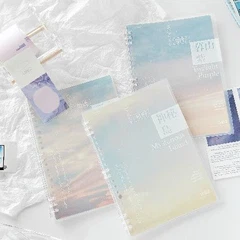
Poetic Fragments Coil Notebook, best notepads for students, line loose leaf paper